2026 Awarded Communities
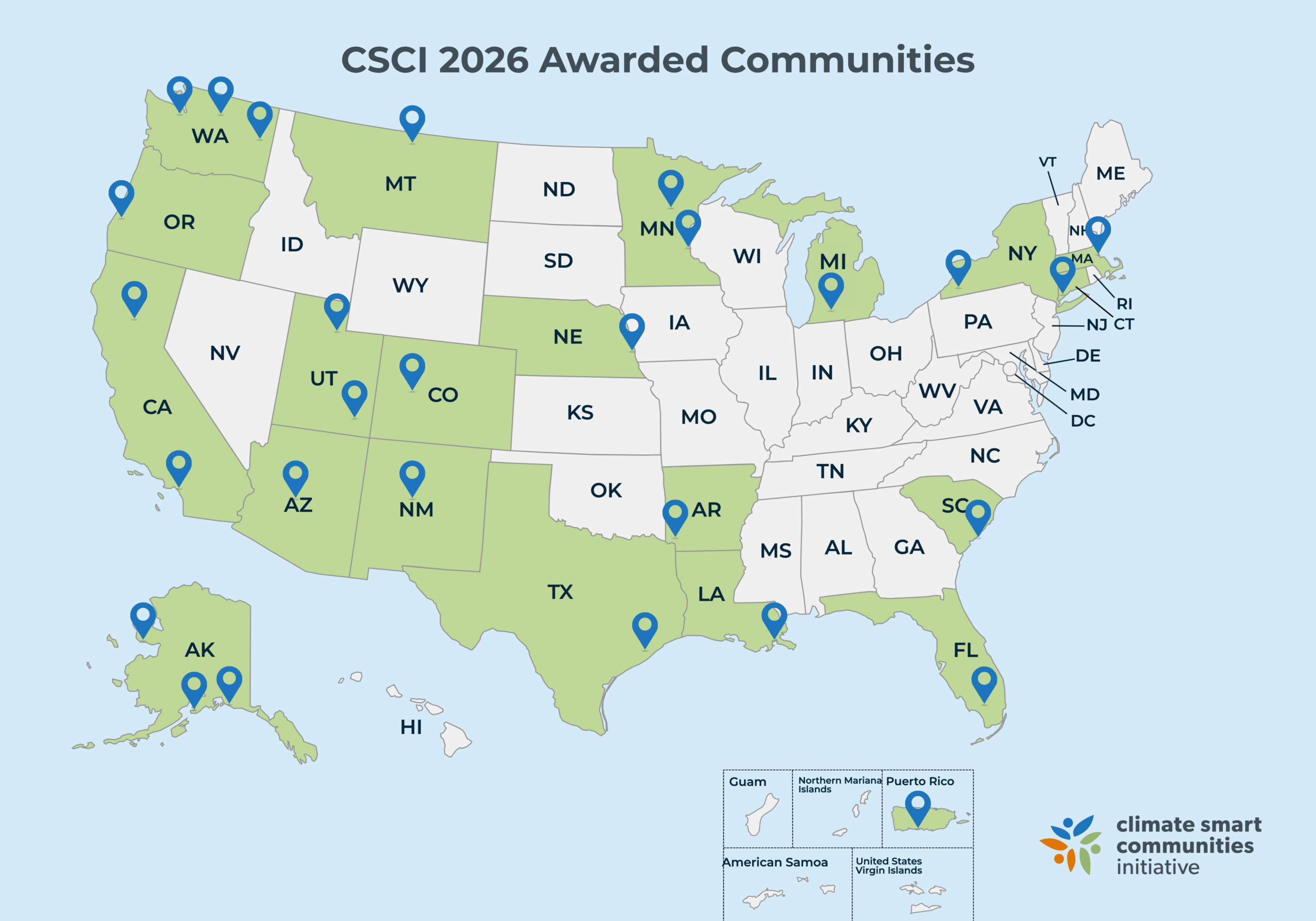
Climate Smart Communities Initiative (CSCI) grants are provided to adaptation experts to work with communities on climate resilience planning or projects. The list below includes awarded communities in 2026 and denotes the community or region where their work is focused.
Alaska: Building Regional Food Security and Resilience in the Bering Strait Region

Recipient: Model Forest Policy Program, Inc.
Project Partners: Model Forest Policy Program, Kawerak, Native Villages of Teller, Mary’s Igloo, and Elim
This project will establish Pilgrim Hot Springs as a regional Community Resilience Hub to strengthen food security across the Bering Strait Region. The team will achieve long-term regional capacity for resilience by creating a Village Food Network and knowledge sharing of nature-based streambank restoration. Core partners, including Model Forest Policy Program, Kawerak, and the Native Villages of Teller, Mary’s Igloo, and Elim, will lead this effort for Alaska native villages facing critical hazards like coastal erosion, extreme storms, and shifting ecosystems that threaten traditional subsistence resources. Nearly $115,000 will provide funding, at minimum, for the native villages of Teller, Mary’s Igloo, Elim, and Kawerak, to foster geothermal agricultural practices, and knowledge sharing to ensure stable, local food distribution.
Contact: Margaret Hall, Associate Director, Model Forest Policy Program, Inc.
Alaska: Securing Cordova’s Water Future Through Collaborative Climate Resilience

Recipient: Prince William Sound Science Center
Project Partners: Prince William Sound Science Center, City of Cordova, the Native Village of Eyak, and the Prince William Sound Economic Development District
The fishing community of Cordova, Alaska, will use this $115,000 grant to build resilience against climate-driven hydrology shifts, including declining snowpack and increasing drought. Funding will support a comprehensive freshwater demand analysis and the modeling of seasonal supply vulnerabilities. To secure long-term freshwater stability and prevent severe summer shortages, the project will also evaluate nature-based and technological solutions, such as beaver dam analogs and snow fencing. Led by core partners the Prince William Sound Science Center, the Prince William Sound Economic Development District, the City of Cordova, and the Native Village of Eyak, the initiative aims to merge freshwater demand analyses, advanced hydrologic modeling, and evaluations of nature-based and technological solutions with community insights to equitably safeguard the local economy and subsistence way of life.
Contact: Marysia Szymkowiak, Director of Coastal Resilience, Prince William Sound Science Center.
Alaska: Advancing Tribally-Led Regional Climate Resilience for the Chugach and Lower Cook Inlet Tribes

Recipient: PICEA Consulting Group
Project Partners: PICEA Consulting Group, Chugach Regional Resources Commission (CRRC), Native Village of Port Graham Tribal Council
This project will strengthen Tribal climate resilience planning across the Chugach and Lower Cook Inlet region through a Tribally led, community-driven planning process. PICEA Consulting Group, the Chugach Regional Resources Commission (CRRC), and the Native Village of Port Graham Tribal Council will work with participating Tribes to develop a Regional Climate Change Strategic Plan. The project partners will examine climate-related challenges including shifting species and ecosystems, coastal hazards, and changing seasonal patterns affecting subsistence resources and community wellbeing. The $115,000 grant will support community listening sessions, Elder-focused community knowledge sharing, Traditional Ecological Knowledge documentation, a climate vulnerability assessment, and updates to the Chugach Region Tribal Conservation District governance structure to strengthen long-term regional climate coordination.
Contact: Chas Jones, Chief Executive Officer, PICEA Consulting Group.
Arizona: Cooling Phoenix’s Sunnyslope Neighborhood through the Water for Shade Project

Recipient: Resilient Cities Catalyst
Project Partners: Resilient Cities Catalyst, City of Phoenix Office of Heat Response and Mitigation, Unlimited Potential
The Water for Shade project will address extreme heat in the Sunnyslope neighborhood of Phoenix, Arizona. The initiative will scale nature-based cooling solutions by assessing the feasibility of a whole-of-community green district focused on this heat-vulnerable community. Resilient Cities Catalyst, the City of Phoenix Office of Heat Response and Mitigation, and Unlimited Potential will collaborate as core partners to develop an implementation roadmap and explore sustainable financing models for tree canopy expansion. This $115,000 grant award will culminate in an actionable plan for place-based greening, including pilot tree plantings and innovative irrigation systems, ultimately reducing the public health risks of extreme temperatures by creating a more connected and shaded urban corridor.
Contact: Anna Friedman, Director of Policy & Programs, Resilient Cities Catalyst.
Arkansas: Building Community-Driven Watershed Resilience in Fulton, McNab, Stamps, and Lewisville

Recipient: Environmental Equity Information Institute
Project Partners: Environmental Equity Information Institute, Visibility Outreach Touch Engage South Arkansas (VOTE SoAR), Town of Fulton Council
The Environmental Equity Information Institute will partner with several partners, including Visibility Outreach Touch Engage South Arkansas (VOTE SOAR) and the Town of Fulton Council to advance community-driven watershed resilience. The $115,000 project will develop a community-endorsed flood resilience roadmap and a regional peer exchange program between the towns of Fulton, McNab, Stamps, and Lewisville by integrating technical flood exposure analysis with community-led participatory mapping and data literacy training. These interventions aim to co-design actionable climate solutions and empower residents to transition from passive information recipients to active agents of change, ultimately reclaiming resilience through community-driven watershed planning and collaborative regional engagement.
Contact: Louise Palmer, Executive Director, Environmental Equity Information Institute.
California: Building Community-Led Climate Resilience in Mineral and Mill Creek

Recipient: Sierra Institute for Community and Environment
Project Partners: Sierra Institute for Community and Environment, South Lassen Watersheds Group, Mineral and Mill Creek Communities
The Sierra Institute and its partners within the South Lassen Watersheds Group will work together to help the Mineral and Mill Creek communities prepare for future wildfire and other climate impacts. Through collaboration with residents, Tribal partners, and technical experts, the project will build a shared vision for protecting and restoring the landscape. Supported by a $100,000 grant, the partners will establish four working groups and work with them to develop a Community-Guided Implementation and Adaptation Plan that identifies restoration priorities, protects water resources, supports healthier forests, and creates a clear path toward implementation and funding.
Contact: Bella Bledsoe, Director of Collaborative Engagement, Sierra Institute for Community and Environment.
California: Advancing Indigenous-Led Climate Resilience and River Restoration in the Santa Ana Watershed

Recipient: American Rivers
Project Partners: American Rivers, Orange County Environmental Justice Education Fund, Gabrieleño/Tongva San Gabriel Band of Mission Indians, Juaneño Band of Mission Indians, Acjachemen Nation-84A, Juaneño Band of Mission Indians Acjachemen Nation-Belardes
This grant will mobilize a collaboration among American Rivers, the Orange County Environmental Justice Education Fund, the Gabrieleño/Tongva San Gabriel Band of Mission Indians, the Juaneño Band of Mission Indians, Acjachemen Nation-84A, and the Juaneño Band of Mission Indians Acjachemen Nation – Belardes to partner on an ambitious Indigenous-led climate resilience project. The $115,000 grant will enable the project partners to develop aquatic and terrestrial restoration designs on the Santa Ana River. This work will focus on the Acjachemen and Tongva Nations and historically disinvested communities in Orange County, California, targeting critical climate hazards, including drought, riverine flooding, and shifting ecosystems. This initiative will employ nature-based solutions and use Indigenous Ecological Knowledge to design de-channelized waterways and restore floodplain ecosystems to improve groundwater quality and mitigate extreme heat.
Contact: Patricia Flores, Associate Director, American Rivers.
Colorado: Co-Developing a Resilience Plan for Carbondale’s Water Future

Recipient: Headwaters Climate
Project Partners: Headwaters Climate, Clean Energy Economy for the Region (CLEER), Lukas Climate, Town of Carbondale
A grant of $109,000 will support a collaborative effort between Headwaters Climate, Clean Energy Economy for the Region (CLEER), Lukas Climate, and the Town of Carbondale to address the impacts of drought, increased wildfire risk, and declining snowpack. The project will develop a plan to secure water and wastewater systems, with a priority on serving historically disinvested populations. Partners will work with the community to co-develop the Carbondale Inclusive Resilience Utilities Plan, which will guide approximately $160 million in future infrastructure investments. These interventions will integrate localized climate modeling with direct community input to identify equitable solutions and essential upgrades, ultimately ensuring water security and long-term resilience for the town’s snowpack-dependent water and wastewater utilities.
Contact: Colin Quinn, Founder, Headwaters Climate.
Connecticut: Advancing Shoreline Resilience in Bridgeport’s West Side

Recipient: Trust for Public Land
Project Partners: Trust for Public Land, PT Partners, City of Bridgeport’s Office of Sustainability
This $115,000 grant will fund a coastal resilience project led by Trust for Public Land, PT Partners, and the City of Bridgeport’s Office of Sustainability. Partners will conduct a comprehensive feasibility study to address air quality impairments, extreme heat, poor water quality, and rising sea levels in Bridgeport’s West Side neighborhood. By leveraging years of grassroots resident organizing and aligning with the community’s broader vision for a 20-mile Waterfront Seawalk, this project will refine community-driven resilience objectives and prioritize options for nature-based shoreline interventions, creating a more sustainable and equitable future for the neighborhood.
Contact: Max Gray, Institutional Giving Director, Trust for Public Land.
Florida: Advancing Miccosukee Tribal Climate Resilience in the Everglades

Recipient: Adaptation International
Project Partners: Adaptation International, Miccosukee Tribe of Indians of Florida, Love The Everglades Movement, Just Collective
The Miccosukee Tribe of Indians of Florida will partner with Adaptation International, Love The Everglades Movement, and Just Collective to enhance community wellness. This project will use the $114,600 grant to host a series of creative participatory workshops to broaden the discussion of climate related risks and responses to the entire community, providing space for multi-generational knowledge sharing and discussing the lived experiences of climate change. The community will co-develop education, outreach, and action toolkits at the family and village scales to prepare for two of the most pressing hazards in the Everglades: extreme heat and flooding.
Contact: Sascha Petersen, Director, Adaptation International.
Louisiana: Translating Local Knowledge to Create a Climate Adaptation Roadmap for New Orleans’ 17th Ward

Recipient: EcoAdapt
Project Partners: EcoAdapt, City of New Orleans Office of Resilience and Sustainability, Hollygrove-Dixon Neighborhood Association
This project will use a $98,500 CSCI grant to support baseline climate research, community forums, risk analysis, and surveys. In partnership with EcoAdapt, the City of New Orleans Office of Resilience and Sustainability, and the Hollygrove-Dixon Neighborhood Association, the initiative focuses on the historically disinvested Gert Town, Hollygrove, and Hollygrove-Dixon neighborhoods in New Orleans’ 17th Ward. The work will address priority climate hazards and impacts, including flooding, extreme heat, and severe storms that threaten aging infrastructure and resident safety. To address these challenges, partners will co-develop a community-informed adaptation roadmap that prioritizes nature-based solutions. The project’s emphasis on translating residents’ lived experiences into practical steps will directly embed equity and community ownership in local climate planning.
Contact: Kathryn Braddock, Lead Scientist, EcoAdapt.
Massachusetts: Building a Community-Led Climate Resilience Framework in Lynn, Massachusetts

Recipient: Emerald Cities Collaborative
Project Partners: Emerald Cities Collaborative, Latino Support Network, City of Lynn Planning Department
This grant will provide $115,000 to develop a community-led Climate Resilience Framework focused on historically disinvested neighborhoods in the city of Lynn. The core partners, Emerald Cities Collaborative, Latino Support Network, and the City of Lynn Planning Department, will address priority climate hazards, including extreme heat, inland and coastal flooding, and sea level rise. To build long-term resilience, the partners will launch a sustained community climate coalition and a resident climate action cohort. This core activity will integrate local voices to translate community priorities into actionable municipal solutions.
Contact: Esmeralda Bisono, Northeast Climate Resilience Manager, Emerald Cities Collaborative.
Michigan: Building Resilience in Kalamazoo’s Edison Neighborhood
Recipient: EcoAdapt
Project Partners: EcoAdapt, Kalamazoo Climate Crisis Coalition, Kalamazoo County, and the Kalamazoo County Land Bank
A $115,000 grant will support a collaborative effort among the Kalamazoo Climate Crisis Coalition, EcoAdapt, Kalamazoo County, and the Kalamazoo County Land Bank to address extreme heat, flooding, and water quality impacts threatening the Edison Neighborhood in Kalamazoo, Michigan. The project will implement a block-scale climate resilience pilot that integrates nature-based stormwater infrastructure with housing rehabilitation in this historically disinvested community. The primary activities include installing green infrastructure, such as rain gardens and bioswales, as well as home energy efficiency and solar upgrades on County Land Bank-controlled properties. These interventions aim to co-create a scalable model for flood-resilient, climate-smart neighborhood design, transforming vacant lots into community assets that enhance long-term resilience and equity.
Contact: Kathryn Braddock, Lead Scientist, EcoAdapt.
Minnesota: Developing Actionable Neighborhood Resilience Solutions in Payne-Phalen

Recipient: WSB
Project Partners: Payne-Phalen Community Council, City of St. Paul, Environmental Institute, WSB
The Payne-Phalen Community Council, the City of St. Paul, Environmental Institute, and WSB will partner to advance climate resilience in the multicultural neighborhood of Payne-Phalen, St. Paul, Minnesota. Payne-Phalen faces significant climate impacts from extreme heat, poor air quality, and severe weather. To build long-term resilience, the partners will create a prioritized Resilience Playbook. In addition to the Playbook, CSCI funds will be used to create a neighborhood-scale portfolio of projects, conduct inclusive multilingual community outreach, and design funder-ready project proposals for future public, private, and philanthropic investments. This work will build on trusted, community-led support networks to directly translate city-wide climate assessments into actionable, culturally rooted neighborhood solutions.
Contact: Katie Baum, Senior Sustainability Planner, WSB.
Montana: Enhancing Rangeland Resilience and Water Security for the Fort Belknap Indian Community

Recipient: Lark Environmental, Inc.
Project Partners: Lark Environmental, Inc., Fort Belknap Indian Community (FBIC) Land Department, Aaniiih Nakoda College, FBIC Environmental Department
A grant of $110,775 will support a collaborative effort between Lark Environmental, the Fort Belknap Indian Community (FBIC) Land Department, Aaniiih Nakoda College, and FBIC Environmental Department to address persistent drought, extreme heat, and water quality impacts threatening the Fort Belknap Indian Reservation. The project will focus on enhancing climate resilience across 700,000 acres of rangelands, prioritizing historically underserved Tribal agricultural producers. Key activities will include conducting a comprehensive, reservation-wide stockwater assessment and maintenance systems, and streambank protection plans. These interventions are designed to secure long-term grassland health, mitigate the stress on livestock water systems, and restore degraded riparian habitats for the Gros Ventre and Assiniboine Tribes.
Contact: Juli Ann McNutt, Adaptation Practitioner, Lark Environmental, Inc.
Nebraska: Rooted in North Omaha: Integrating Regenerative Land Practices and Climate Resilience

Recipient: Verdis Group
Project Partners: Verdis Group, Comunidad Maya Pixan Ixim, and the Papio-Missouri River Natural Resources District
The “Rooted in North Omaha” project will focus on the Maya community and leaders from the greater North Omaha region. Core partners include the Verdis Group, Comunidad Maya Pixan Ixim, and the Papio-Missouri River Natural Resources District. Together, they will collaborate to address climate hazards: extreme heat, flooding, and poor air quality. The $96,440 grant will support the development of a community-led climate resilience plan that will integrate nature-based strategies to safeguard transportation infrastructure along the Beltline Trail corridor. Maya-led regenerative land practices will complement the planned regional trail infrastructure, elevating climate resilience planning in a historically redlined urban neighborhood.
Contact: Grace Thomas, Verdis Group, Manager of Sustainability Services.
New Mexico: Advancing Neighborhood Resilience in the South Valley and International District of Albuquerque

Recipient: Spatial Informatics Group Natural Assets Laboratory (SIG-NAL)
Project Partners: Spatial Informatics Group Natural Assets Laboratory (SIG-NAL), Ciudad Soil and Water Conservation District, Bernalillo County, Tree New Mexico
This project will utilize a $115,000 CSCI grant to formalize the Rain to Roots program, a community-centered initiative dedicated to expanding passive rainwater harvesting. Core partners, including Spatial Informatics Group Natural Assets Laboratory (SIG-NAL), Ciudad Soil and Water Conservation District, Bernalillo County, and Tree New Mexico, will focus their efforts on historically disinvested populations in Albuquerque’s South Valley and International District. The work will address extreme heat, drought, and flooding. The team will conduct hands-on education and installation workshops that teach volunteers to create earthworks like bioswales and rain gardens towards greater environmental and social resilience. These solutions will capture stormwater to irrigate native trees, cooling neighborhoods, and protecting vital water resources.
Contact: Shelby Stimson, Resilient Cities Program Manager, Spatial Informatics Group Natural Assets Laboratory (SIG-NAL).
New York: Co-Developing a Climate Adaptation Plan for the Seneca Nation

Recipient: VIRGA Tribal Solutions LLC
Project Partners: Seneca Nation, VIRGA Tribal Solutions LLC, Just Collective
The Seneca Nation, in partnership with VIRGA Tribal Solutions LLC and Just Collective, has been awarded $115,000 to co-develop a Climate Adaptation Plan rooted in Seneca values and culture. This project integrates climate science with traditional ecological knowledge to address the urgent threats of extreme heat, flooding, and shifting ecosystems to Seneca infrastructure, food systems and community health. Partners will collaborate to create an implementation-ready roadmap ensuring climate adaptation strategies honor intergenerational responsibilities and long-term resilience for the community.
Contact: Jennifer Santry, Chief Executive Officer, VIRGA Tribal Solutions LLC
Oregon: Updating the Coos Bay Estuary Management Plan for Coastal Climate Resilience

Recipient: Sea & Shore Solutions, LLC
Project Partners: Coos County, the Coos Watershed Association, Sea & Shore Solutions
This $115,000 grant will support ongoing efforts to update the Coos Bay Estuary Management Plan, a multi-jurisdictional regulatory document that establishes policies to manage and use Oregon’s Coos Estuary. The plan will, in part, address coastal erosion, sea level rise, flooding, and ecosystem shifts. Collaborative partners including Coos County, the Coos Watershed Association, and Sea & Shore Solutions will focus on community education and engagement and developing an updated aquatic boundary map. A central feature of the project is a robust, inclusive strategy to empower marginalized communities to actively engage in local land use policy development.
Contact: Adrian Laufer, Chief Executive Officer, Sea & Shore Solutions, LLC.
Texas: Building the Alief Nature Network for Equitable Climate Resilience

Recipient: Resilient Cities Network
Project Partners: AliefVotes, Resilient Cities Network, City of Houston
This project will establish the Alief Nature Network, a collaboration that will mobilize to address the impacts of extreme heat, flooding and poor air quality facing the diverse, historically disinvested community of Alief in Houston, Texas. Alief is facing a combination of climate-related risks, including extreme heat, flooding, and poor air quality. The $115,000 grant will enable core partners AliefVotes, Resilient Cities Network, and the City of Houston to plan and implement nature-based pilot projects and integrate them into a network of rain gardens, pocket prairies, and urban tree plantings. The initiative will enable residents to steward climate interventions through placemaking workshops and civic science programs to create a community-informed adaptation roadmap. Ultimately, this work will create a scalable model for neighborhood resilience that cools the environment and manages stormwater.
Contact: James Neimeister, Communications Associate, Resilient Cities Network.
Utah: Implementing a Circular Carbon System in Park City and Summit County

Recipient: Circular Spring
Project Partners: Circular Spring, Park City Municipal Corporation, Summit Land Conservancy
This project will design a regional circular carbon system to address the escalating threats of wildfire, drought, and extreme precipitation in Park City and Summit County, Utah. The awarded $108,000 will enable core partners – Circular Spring, Park City Municipal Corporation, and Summit Land Conservancy – to identify the partners, feedstocks, technologies, and financial frameworks necessary to establish a community-scale biochar system. The project will assess the conversion of local biomass waste into biochar to enhance soil health and water retention. This nature-based solution will reduce hazardous wildfire fuels and strengthen landscape resilience to address prolonged drought while focusing on benefits for primary residents, seasonal workforce communities, and rural agricultural families.
Contact: Korina Stark, Founding Partner, Circular Spring.
Utah: Enhancing Watershed Resilience through Community-Scale Biochar Production in San Juan County

Recipient: Circular Spring
Project Partners: San Juan County, ProgramEarth, Circular Spring
In a collaborative effort, San Juan County, ProgramEarth, and Circular Spring will tackle critical challenges related to impaired water quality, extreme precipitation, and drought. The project will focus on rural communities in San Juan County, Utah, including Bluff, Blanding, and chapters of the Navajo Nation and Ute Mountain Ute Tribe White Mesa. The $115,000 CSCI award will support nature-based soil restoration by transforming invasive riparian biomass into locally produced biochar and integrating it with compost to enhance soil water retention. The project will bridge environmental monitoring tools with traditional ecological knowledge to ensure long-term, community-led land stewardship.
Contact: Korina Stark, Founding Partner, Circular Spring.
Washington: Assessing Climate Vulnerabilities on the Kalispel Reservation
Recipient: University of Washington Climate Impacts Group
Project Partners: Kalispel Tribe, University of Washington Climate Impacts Group, Kalispel Public Works Advisory Committee
The Kalispel Tribe, the University of Washington Climate Impacts Group, and the Kalispel Public Works Advisory Committee will collaborate to address critical water-related climate hazards focusing on the Kalispel community. The project will address urgent climate-related impacts including flooding, drought, and stormwater infrastructure degradation. The $115,000 CSCI grant will support staff coordination and data collection to complete a Drought, Flood, and Stormwater Vulnerability Assessment for the protection of critical infrastructure and natural habitats. By integrating localized community outreach, the project will align future climate investments with Kalispel values.
Contact: Anne Thebo, Research Scientist, University of Washington, Climate Impacts Group.
Washington: Climate Change Vulnerability Assessment of Culturally Important Plants and Ecosystems in the Kitsap Peninsula

Recipient: Haven Ecology and Research LLC
Project Partners: Great Peninsula Conservancy, Port Gamble S’Klallam Tribe, Suquamish Tribe, Haven Ecology and Research LLC
This $114,000 grant award will support a collaboration between Great Peninsula Conservancy, the Port Gamble S’Klallam Tribe, the Suquamish Tribe, and Haven Ecology and Research LLC. This project will evaluate drought, extreme heat, and shifting ecosystem impacts affecting the Coast Salish communities in Kitsap County and Jefferson County. Upland ecosystems and culturally important plants are experiencing severe stress, threatening traditional medicines, food, and other natural resources central to the commerce, sustenance, and ceremony of the Tribes. To address these impacts, partners will perform a sector-based natural resources assessment, utilizing quantitative spatial analysis and field-based ground-truthing to identify potential climate refugia. Traditional ecological knowledge systems will be interwoven with advanced data science workflows, directly empowering Tribal communities to preserve vital native ecosystems for future generations.
Contact: Dylan Mendenhall, Principal Ecologist, Haven Ecology and Research LLC.
Washington: Developing a Wildfire Adaptation Toolkit for the Town of Winthrop

Recipient: The Keystone Concept
Project Partners: The Keystone Concept, Fire Adapted Methow, Town of Winthrop
The Town of Winthrop, Washington, is experiencing changing seasonality, prolonged periods of drought, and escalating wildfire risk. The project team and local stakeholders will utilize CSCI funding to develop and pilot a Fire Resiliency Toolkit and collaborative governance model for rural townscapes that are confronting accelerating climate challenges at the wildland-urban interface. The Toolkit, governance model, and implementation templates developed through this effort will guide the Town of Winthrop toward health and resilience and provide a replicable, equitable model for rural, amenity-dependent communities across the United States. The project team includes The Keystone Concept, Fire Adapted Methow, and the Town of Winthrop.
Contact: Lance Davisson, Owner, The Keystone Concept.